Thursday, June 11, 2009
Processing
These are a series of poems about childhood. For the first time I am sharing about the pain. Each unit of Processing is a specific memory, but not in chronological sequence.


Tuesday, June 2, 2009
Standing in the Yard at Night
[What is the speed of Light? A million galaxies, a quantum leap? The scientists tell us space travel is impossible. Truly?]
(April 21, 2009) Jaffrey, NH
Three fingers
Three stars
The scientists are wrong
Close, I see them
Close, I touch them,
Close, heart beats
Flicker in time
With their shimmer
Three stars
Touched
Home
McMommy
June 2, 2009
That quick pinging is the French fry timer. It is time to shake those fries so they do not stick together.
The longer ping is the basket on the left side of the fryer. Those fries are done and need to be drained and gently emptied into the bin. And that other steady bell that is a half pitch lower in musical tone? That is one of the alerts to let the grill team know that they need fresh-cooked hamburgers.
The shake machine has a soft low tone. The back grill buzzes when hot, when cooking, when done. The pie oven dings when the pies are baked. Near the front counter the reach-in refrigerator fan turns on, followed closely by the motor for the ice cream mixer.
These are the normal noises that flow through the day at my McDonald’s restaurant. They happen frequently and often in synchronicity. They have no respect for my customers. Through this noise I need to be able to focus on my patrons, I need to accurately hear their orders, direct questions to clarify their needs, and then speedily enter this information into the computer system so that their food products are communicated to the grill team.
Fast food, not instant.
Friends who know me marvel that I can not only survive but thrive in this sensory magnified environment. I regularly field the question “You are so smart—how can you work at McDonald’s?” It is true, I am smart. I have taught at the university level. I give workshops to professionals about autism. I am published. I am a member of the Freedom Writers’ Foundation and a contributor to their recent book, Teaching Hope. I have written dinner theater, acted, directed and designed for the theater.
Yet I love my “McJob.” After 3 hours serving customers during a busy lunch rush my hearing is compromised. It is difficult for me to filter out all the sounds, to filter and distinguish the vowels and consonants in shared speech between me the server and my customer, the served. If I am not cautious about creating a sensory break, about renewing my ability to discriminate sound bytes, then I fail in providing a quality service.
There is also the social side of working the front counter at McD’s. The rules of engagement are clear: 1. Smile; 2. Greet the customer, personally if possible, making eye contact (if possible); 3. Encourage the visitors and listen to their order; 4. Ask for and receive payment; Thank the customer; and 5. Present hot food with a smile.
Now that is a simple social pragmatics program! I get to practice this pattern over and over, changing my smile, my one line quips, the way I tilt my head to show I am listening, and enjoying every moment. The exchanges are short. I do not have to continue any complex social chatter. Dialogue is short so I do not have an opportunity to soliloquize about my favorite and arcane topics. Perhaps best of all my quirky mannerisms—quoting lyrics from 1970’s love songs, imitating famous film lines, creating goofy faces—invite laughter and easygoing banter.
This is great. I have had many types of employment. I have worked in accounting, data entry, marketing, personal care, and entertainment roles. I have developed curriculum, written and graded exams, and worked in desegregation programs.
Nowhere has there been a position where I can smile the entire time I am working and get smiles back most of the time. Not only do I have short but happy interactions with my customers, I work on using my unique way of thinking and perceiving to create relationships with my crew members.
Back in high school at my very first McD’s job, I was a social misfit who was good at the rules, fast with service, and shy. Eight years ago I took my children on a tour of my hometown. Unbelievable, but the store manager remembered me, and offered me a job. I worked at a store in Atlanta and in St. Louis. When I needed a bit of extra income (dratted car payments) I took on the store here in southern New Hampshire.
Of course I am much older, quite a bit heavier (was I really a beach bunny?), and my hair is so gray it no longer holds hair color. I have come to peace with my oddness. I no longer care if I fit in with people.
I do care if I fit in my clothes.
I do care that I fit the profile of a hard worker, and a compassionate co-worker.
Now, not only do I work at this restaurant, but when I first joined the crew my eldest son also worked at this restaurant. That was five years ago. He worked at a store in Pennsylvania where he attended college and now in Florida he works for a corporately owned restaurant where he is learning management. Now at the small McCafe in rural New Hampshire my daughter is an award winning employee, my middle son works in the grill area, and my fourth child who is 15 wants to know when he can apply.
We are now the McEdscorn’s. Where I once was the shy, cautious customer service crew member, I am now the laughing and playful expert. I am the oldest front counter person, and by that virtue (and the compassion and experience I project) I have been adopted as McMommy by my much younger cohorts. They confide their hurts, their worries and their concerns to me. They know they can get a hug from me. They know that if something goes wrong, I am logical, calm, and knowledgeable and that I take action to solve personal and customer relationships.
Somehow, the gangly awkward young adult, the peculiar young woman with language idiosyncrasies, has become cool.
I answer those who wonder how I can possibly work in the noisy, fast-paced environment, that this is the only job where I can smile at people for 4 or more hours straight out and have people smile back.
McMommy…I’m lovin’ it.
END
Tuesday, March 24, 2009
Civil RIghts and Civility
At the ripe old age of 55 I am finally reading To Kill a Mockingbird. I read the first half of the novel in 2 hours but found myself stretched between needing sleep and needing to mourn the departure of my eldest son, who left March 22nd for Florida.
My middle son is reading this incredible story for high school literature, and I am being supportive. He has the book on CD so he can listen to it while driving about town. I rented the film featuring the superb Gregory Peck as Atticus Finch. I am reading the volume so we can dialogue about the language, themes, characters and plot.
Wondering about this literary gap in my life I cast back through my memory: why should I have avoided this classic? Then I remembered that the premise of the book was a small town lawyer doing the Right Thing in a rape case involving a black man. My parents would not have let me read this book in 1970. I must have read a substitute assignment. And racism never came up as a discussion.
But I was not unaware.
He was a gorgeous shade of deep chocolate, the first black I had ever seen in person. An adult, he seemed to suddenly appear at my church one Sunday as a cantor. He introduces himself prior to worship, and then he sings.
I love singing in church, but I preferred to listen to him, enrapt, sure I was hearing echoes from Heaven. After a few Sundays I sang with him, inspired, and I promised myself that I would always sing. Then our family moved and I began a new life in a new school.
Moving from New Britain to North Haven felt like a total upheaval. On the map it is a mere 30 miles. School life was no better. I watched from the trees on the playground during recess, I ate lunch alone.
Then I met Garth. He was very dark, beautiful, with long fingers and I knew he could play piano whereas my fingers are short. I envied him. I adored his hair which he let me touch, and his deep eyes that glistened with an inner light.
My fourth grade classmates stared at him in a similar fashion as they stared at me, placing us in a relationship affirmed when Mrs. Burns seated us side by side. Garth was a meticulous artist, and he taught me techniques to improve my drawings. In return, I taught him to knit. I am certain that neither activity endeared us to our competitive peers. With hindsight, I believe prejudice was active and ingrained in southern Connecticut. A student boldly labeled me “nigger lover” when Mrs. Burns left the classroom one time. I had heard the word nigger, but had no framework for interpreting it. I knew the word lover. So the intent was not received, it actually had the opposite effect. I was happy to love this young man who accepted me and interacted with me in a gentle, kind manner.
In the mysterious manner of school boards, the school zones were redrawn and I went to a different school for fifth grade and when I returned to grammar school Garth had disappeared. It was years before I saw another black person.
My family moved to New Hampshire for a year, and relocated to Rhode Island for my eighth grade adventure. I was in tenth grade when Debra and her family moved into town. She was striking, poised and articulate. She joined the cheerleaders so I was not in her circle, but she was in many of the advanced courses with me so I got to know about her. Her parents were professionals, well-educated and involved in the community. In the spring of our junior year I discovered that racial meanness was strong in southern Rhode Island. When Debra did not show up for school one day it quickly came out that a large cross was placed on her family’s front yard and set ablaze.
This awareness set me on a path. I become involved at a young age in the Civil Rights movement, and this has remained close to my heart.
It is in The Constitution of the United States—all men are created equal. This includes the elderly, sequestered in institutions. Youth trapped in barrios and ghettoes are excluded from life, liberty and the pursuit of happiness. The population we brazenly label ‘disabled’ are the final frontier in Civil Rights, and this shall be a long battle as our society and culture is deeply embedded with presumptions, prejudices, fears and misnomers. It is one thing to choose to be a maverick, a loner. It is another issue when an entire mindset needs changing.
So I read To Kill a Mockingbird 49 years after it was published. It is the only novel that Harper Lee wrote. It is powerful, her characters full of life, of human glitches, of love. It is powerful, unafraid of exposing small town traits, small people, and large evil. It is powerful, using touch words, tightly Southern dialects, images built up in the heat of Alabama, the relentless slowness that builds decades of dark secrets. I can read and digest and glory in Lee’s written legacy.
I hope I can share that with my young son.
Friday, December 19, 2008
I wrote this in response to a criticism. Someone did not think I was "autistic enough" as she did not notice me quoting from television. As I have not watched much television in 25 years I had to recall the common phrases I used as a teen. This was written in October 2008.
Articulate Aspergian Quoting
I am California Dreaming
As I reach out for Good Vibrations
And With a Little Help from my Friends
I will gleefully Sit on the Dock of a Bay
And my mission-should I choose to accept it-
Will be to Never Give up, Never Surrender!
I do not look for trouble
But trouble always seems to find me;
When I am Lost in Translation
I Phone Home so I can Be Good;
And my mission-should I choose to accept it-
Is to Boldly Go where No One has gone Before!
Being a Stranger in a Strange Land
Allows me to Quantum Leap through time
Although I do not know
What Not to Wear, and
Apparently what not to say,
My mission-should I choose to accept it-
Is to Reach out, reach out and touch someone.
If life is just a bowl of cherries
Then are we not all Fruit Loops?
And if Time can put in a Bottle,
Then what is the next thing that I should do?
My mission-should I choose to accept it-
Is to be a Myth Buster!
Can I Sing Clearly now?
While Walking on Sunshine,
Putting a Little Love in My Heart,
I will Never Walk Alone.
My mission-should I choose to accept it-
Is if music be the food of Love, I will play on.
I just do not want to be an Oscar Mayer Weiner.
Married, with Asperger's
Published in AANE Journal November 2008
Married, with Asperger’s
He is finally trained! My husband of 26 years has not completed a sentence but once this year. Like most neurotypical people, Christopher has a tendency to want to finish someone’s sentence when there is a pause. That is not helpful for me.
I received my diagnosis of Asperger’s Syndrome in 1994 shortly after the birth of our fourth child. This was a wonderful event for me! Finally there was an explanation for lost jobs, lost friends, and lost opportunities. My husband spied an article taped to the classroom door of a colleague about Temple Grandin, snatched it and photocopied it. He immediately recognized her pattern of thought and behaviors as similar to those of his wife. We went to a local specialist. Then I went to a regional expert. And after the birth of our fifth child I spent two years with a psychologist friend sorting out my past and healing my wounded heart.
Until recently women were not diagnosed with Autism conditions. I did not speak until I was almost 4 years old. My mother thought that being quiet was a gift. I was a very “easy” baby. I had numerous infections, particularly ear infections, and was subjected to many antibiotic treatments. Some of these resulted in life threatening reactions.
I was a loner, preferring the woodlands and lakes and streams to people. I was never read to and I suspect my language developed as a result of the television—particularly soap operas—being on all day. In school I continued my aloneness, lurking near the trees at the edge of the playground and watching the other children play games, screaming and laughing. I refused to participate in group discussions or reading time, preferring the art table and making painting after painting with my fingers. I also enjoyed sculpting with clay.
In third grade I was tested and my IQ was rated at 80, but the teachers thought I was bright. In fourth grade my teacher demanded that I learn to read. Apparently I was the class clown, “reading” the pictures in our books. I did learn but reading was very difficult until sixth grade when I learned to speed read. Finally the words on the page made pictures and my expressive skills, especially writing, caught up with my receptive skills! By tenth grade I was tested with an IQ of 150.
But I was always the odd one, shunned by the cool crowd. This shifted a little bit when I learned to play guitar and later became involved with the drama club.
I never wanted to get married or have children, and the fact that I have been married for 26 years and have 5 children amazes me. My eldest son is 22. He experienced what is now termed regressive autism just before his first birthday. I spent the next 18 months ignoring housework and playing with him on the floor, invading his space. What I did is similar to Dr. Stanley Greenspan’s Floortime®. He has since pursued an associate’s degree in his special area of interest—cars.
My daughter at age 19 is much more typical in her behaviors. She is very social, outgoing, and intelligent. Our third child is 18 and struggled with ADHD. They are both attending community college part time. Our fourth child is now 14 and is our Asperger’s child. It is difficult because even though I know so much about autism he is very different from me and my heart hurts as I watch him struggle with the social rules. Our youngest son is almost 10 and 100% boy, running about, engaging in active play, chattering excitedly about whatever interests him at the moment.
I home educate all our children. And my husband, who is a special education teacher at the upper elementary level. When I recently went to a neurologist for follow up tests he wryly suggested that I was my husband’s best student. I immediately retorted “No, he is mine.”
And this is true, as Christopher regularly requests my insight with his students on the spectrum!
For 12 years I did nothing about my diagnosis except further my own understanding and develop more sensory adaptations. If a crisis occurred in a relationship I explained autism and its ramifications. Sadly the most frequent response to continued faux pas was along the line “I can’t deal with you anymore…I can’t believe that someone so smart can be so stupid.”
This brings me back to my family and life with Asperger’s Syndrome. My children are well-trained. I often disappear into the bathroom when I need a sensory break, a quiet withdrawal from the constant noise of boys and chatter of girls. They know to not approach me unless someone is close to dying. In the car we have a code. “Mamie’s on overload” is the phrase for turning off the radio, turning down the air conditioner, and reducing interactions. When we enter a city enroute to visiting family I state “We are all on silence until we are out of traffic.” I think that this might make them prone to entering a monastery, but they all understand that I have to completely focus on the numerous automobiles and dangerous drivers in high traffic. And they all know to not finish my sentences!
Last Spring I proffered my usual apology for not bringing them up in a normal fashion. We were driving around town on errands and I was feeling sad about something. My middle son smiled calmly and replied “That’s okay, Mamie. We prefer to be lamron.” It didn’t take me long to realize this was normal—backward.
So one positive result of living with a mother with sensory and cognitive difficulties is that my children have a great sense of humor!
My husband has been so supportive and he regularly illuminates my differences with excellent metaphors. The most useful one is that he compares my mind to 30 Pentium II® processors. I am always running the permutations of a social circumstance, what do people intend? What does this person mean? What is the appropriate response? It explains how it appears that I am distracted but I am actually running programs until I find the best one for an event or interaction.
Some of the relationship challenges are due to word usage. I used to read the dictionary and I use words literally. I have gotten better with metaphors, but I prefer to think of these as parallels, looking for events that mimic the pattern that I am seeing in daily life. Puns are not just “groaners” for me, they are outright incomprehensible! Jokes follow the same response: “Um.” This is mostly a problem for that certain age amongst young boys when they discover joke and riddle books. So I have had nearly a decade of practice in understanding humor! What’s invisible and smells like carrots? Bunny farts! Oh yes, little boy humor is amazing!
When I was in my 20’s I was attracted to organic gardening and natural foods. I was alert 30 years ago to gluten and dairy sensitivities. So I have been eating similar to the DAN! protocol for decades. This is how I meet so many parents who have recently diagnosed children. I am standing in the natural, gluten free foods at the supermarket and there is a mother (usually!) with a sheaf of papers and tears in her eyes. When she notices my confident acquisition of food products she asks “Do you know about gluten free diets?” My positive response encourages her and we exchange phone numbers.
Now, added to my family activities, are many presentations across the region and now in California and Tennessee at the national TASH disability rights conference. As I interacted with all these families I realized that I have something important to offer: hope. Two years ago I went to a family support workshop called “Building Social Bridges” presented by Cathy Apfel. Two other mothers were supposed to attend with me but they bowed out at the last moment. I hate crowds but I chose to attend this meeting anyway. I got there later than when I prefer so I could not sit down near the escape path and in front at the edge of the crowd—and it was crowded! As the workshop proceeded, I asked a lot of questions, and I had a lot of answers. It became almost a private conversation with Cathy, and we exchanged email addresses. I tried to escape but I was cornered by a group of parents. This frightened me enormously, but it was also that epiphany, the moment when I realized that what I had accomplished in my life and family could offer hope and courage to families with children on the spectrum.
Cathy is now my closest friend. She is like my husband, calm, and good with explanations. She helps me interpret the social rules, and her encouragement keeps me going. I do presentations with her now through the Institute on Disability/UCE (UNH) as well as presentations to schools and support groups. My husband is supportive and radiantly tells everyone that his wife is a great presenter. My children think that my workshops are fun even though they also miss me when I am away.
As for me, I finally feel like planet Earth feels like a safe place, almost like home. When the film ET came out, I cried through much of it, particularly when the little alien plaintively pointed to the stars and said “Home—phone home.” My earliest memories are of late nights, gazing out of my bedroom window at the constellations and wondering when I might go home. I knew I did not “fit in” at an early age. Now I know many Asperger adults and youth with the same longing for home and love of the stars, of all things sparkly or shiny.
I have begun giving myself little gifts. I eat my food the way I want to—in orderly patterns, one color at a time, and often with a spoon as I am still dyslexic. I wear clothing in unusual combinations. Recently a coworker inquired on a casual dress day if my cape and scarf were part of my costume. Of course they weren’t! Most especially I give myself permission to close or direct my eye gaze when and where I want, controlling sensory overload and that sense of invasion that eye contact brings on. After five babies I am comfortable gently rocking and even occasionally spinning. I carry fidgets like smooth stones or Silly Putty® in my pockets, and I am unconcerned about taking them out when they are needed. My best gift is my service dog, Shakespeare Aristotle, a dachshund mix who I trained for voice and hand signals. When I travel he is my best friend, keeping me calm and centered in busy airports and metropolitan centers.
I work at McDonald’s, which is not the best job for sensory issues with all the beeps and buzzers and machinery fans blowing. But I worked at McDonald’s as a teenager and it has good and fun memories. I took the risk of disclosing my diagnosis and explaining what I needed from management and they are doing it! They use my name and explain fully what they need. I get little breaks after lunch rush. I love this job because all of the policies are clearly explained and the routine—“Hi! Welcome to McDonald’s!”—is constant. I do not have to become anyone’s friend so I am free to be a bit goofy. Best of all I get to talk with parents and grandparents when they bring in their children who—to me—are obviously on the autism spectrum. It is a little thing, but it is one more time where I can educate a little bit and encourage a whole lot.
That is the greatest gift of life with family. When I have a meltdown, they love me anyway. When I wear weird clothing, they love me anyway. When I do not get their jokes, they explain them and then actually repeat them so I get to laugh with them. When I cannot stand to be touched or hugged they blow me kisses. When we argue because I so did not “get” their choice of words (and this happens A LOT in adolescence!), they are willing to talk it out, and we grow closer. This empowers me to keep going, to keep talking to others. I have my “anchor.” I have examples of loving behavior that I can reflect back to others in my community.
After 54 years on planet Earth, I have a mission, and I choose to accept it.
Wednesday, May 7, 2008
Your Mission, should you choose to accept it...
A history Lesson
Another job lost. Another friend departs. What was I doing wrong?
In 1993 my husband Christopher saw a newspaper articles on Temple Grandin, photocopied it and brought it home. Shortly thereafter I received my diagnosis: Asperger’s Syndrome.
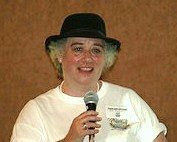
My name is CarolAnn Edscorn and I live in Jaffrey, NH, with my husband, five children, two dogs and two cats. My age is a bit past the half-century mark. I am a published essayist, artist, and playwright as well as a musician and songwriter. I have a Bachelor of Fine Arts degree in Acting and Directing, a Master of Science in Urban Affairs Management and Public Policy Analysis (focusing on health and education issues) and I just completed the Autism Spectrum (Disorder) Certificate Program at Antioch University in Keene, NH.
I was recently invited to be on the Leadership Board for the New Hampshire chapter of Asperger’s Association of New England (AANE).
When I learned about Asperger’s Syndrome I was so happy! Finally! An explanation of all the gaffes and social faux pas and misunderstandings in my life was and is a blessing for my family and me.
However, I did nothing for others living in autism. Life went on and I researched books, then all over the Web—which confused me a lot at first, until I found the ‘threads’ that wove a beautiful comforter. I went to church, performed in community theater, and lost jobs and lost friends. I didn’t change. I didn’t take any Real Risks. I pretended to be normal still.
Then, in October of 2006, I went to a presentation on Building Social Bridges by Cathy Apfel at The Family Center of Peterborough. I was supposed to go with two mothers with children of autism but they canceled. Grabbing a bit of courage I went anyway, alone. The fear and anger in the room was palpable to me. Parents were yearning for answers, for hope, for methods that would improve the lives of their children. I kept asking questions, sharing my life and what I knew then. (I know a lot more now!) Afterward I tried to escape. Sensory overload is a powerful motivator. But parents were asking me questions, and searching so hard for hope. They surrounded me. I could give that to them.
Cathy Apfel took my email address and phone number. This began my new journey and a great new friendship. I met with the Institute on Disability representatives and set up a workshop with Cathy. That was in March of 2007. Then the IOD invited me to be a keynote speaker at their Autism Summer Institute, along with facilitating the workshops. My topic was Presuming Competence in Friendship. I cried a lot writing that presentation. I did not feel at all competent in making and keeping friends! But myself-reflections were important and radiated hope to many educators and parents attending the Institute.
I gave another Building Social Bridges workshop in October of 2007 and again this past April. I have offered independent teacher workshops. I enrolled at Antioch University New England where I met many wonderful educators, parents, and speech and language professionals. I now have the words and methodologies for better communication.
I met Erin Gruwell of the Freedom Writers’ Foundation and have been to Los Angeles twice now to witness to hope and freedom. Jeff Strully has invited Cathy and myself to the national TASH conference in Nashville. AANE has invited me to present at their major regional conference this coming October. The local parent support group wants me to present a series of topics.
My family is proud of me for finding my voice finally and having the courage to go out into the world and help others. Most of my life my ‘voice’ has been quotes from books, movies, poetry and especially songs. Now I have my own voice, my own words. And if I can help parents and educators understand the truth about autism, then I am changing the world for good.
I offer workshops both through the IOD and as an independent contractor. I will again be a keynote speaker at the IOD’s Autism Summer Institute in August at UNH. I am in the processing of signing a book proposal. I have a blog site and a Web site. I even have business cards and brochures. Such a new adventure!
All of this is possible because of my new friends and mentors, Cathy Apfel and Shelley Viles who is the ASD graduate program director and on the Leadership Board of the AANE New Hampshire chapter. My family is fabulous—an example of love, encouragement, and being truly present.
This is the mission of my life: to spread hope and reframe the dreams. Autism is here. Autism is a gift. Join the journey. Embrace the joy.
Subscribe to:
Posts (Atom)